From Automated Workflows to end-to-end AI-Assisted Investigations
In our previous article, we explored how organisations can move from fragmented, manual investigation processes to structured, automated, and intelligent workflows. The benefits are significant: improved consistency, faster execution, better governance, and greater operational scalability.
However, workflow automation is only the beginning.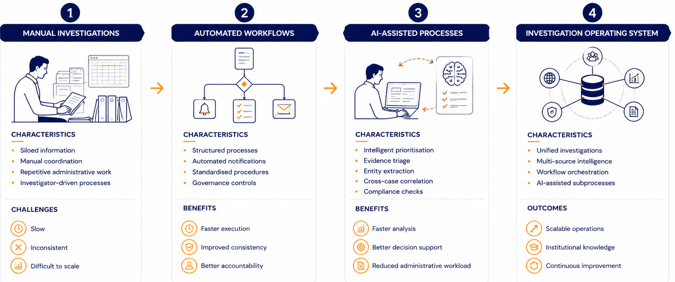
The next evolution is the introduction of AI-assisted capabilities within investigation workflows. Rather than simply automating tasks, organisations are embedding intelligence into specific stages of the investigative process to accelerate analysis, prioritisation, and decision support.
AI is not replacing investigators. It is enabling investigators, analysts, compliance officers, and forensic specialists to focus their expertise where it creates the greatest value.
The limits of traditional automation
Most workflow automation solutions are designed around predefined rules.
• If an event occurs, a specific action is triggered.
• If an approval is granted, the next task begins.
• If a case reaches a defined status, notifications are sent.
These capabilities improve efficiency, but they cannot understand context, evaluate priorities, identify emerging risks, or support investigative decision-making.
As investigation environments become more complex, organisations need systems that can contribute intelligence, not just execute workflows.
Introducing AI-assisted workflow components
Modern investigation workflows increasingly combine process orchestration with AI-assisted decision support.
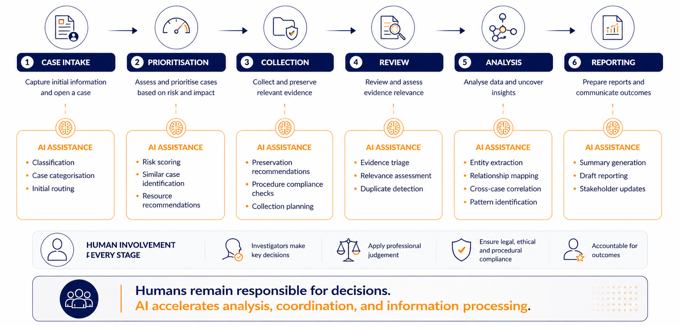
Rather than automating entire investigations, organisations are embedding intelligence into workflow stages where repetitive analysis, triage, enrichment, and coordination activities can be accelerated safely and transparently.
Examples include:
• analysing incoming requests and supporting prioritisation
• recommending collection and preservation actions
• surfacing relevant intelligence signals across cases and datasets
• supporting evidence review, triage, and investigative gap analysis
• generating draft summaries, reports, and compliance documentation
The result is a workflow where specific subprocesses can operate with AI-assisted autonomy, while investigators retain ownership of decisions, conclusions, and outcomes.
Amplifying investigative capacity
Investigation teams face a common challenge.
Data volumes continue to increase while specialist resources remain constrained. At the same time, organisations are expected to process more information, more quickly, and with greater accountability across digital forensics, internal investigations, eDiscovery, compliance, incident response, and intelligence operations.
AI-enabled workflows help bridge this gap.
AI can summarise large document collections, identify entities and relationships, prioritise material for review, surface missing investigative steps, and correlate information across multiple sources.
These capabilities do not replace investigative judgement. They allow experts to spend less time finding information and more time interpreting it.
Building an investigation operating system
Many organisations approach AI through isolated pilot projects.
• A chatbot here.
• A summarisation tool there.
• An analytics platform somewhere else.
The challenge is that investigations rarely happen within a single application.
Real investigations span people, systems, evidence sources, review platforms, legal requirements, and reporting obligations.
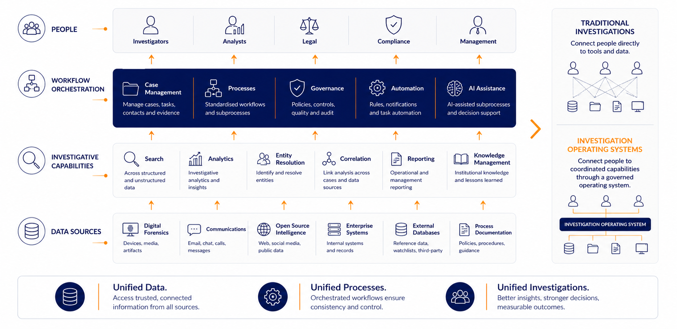
The organisations achieving the greatest success are not deploying individual AI tools. They are building investigation operating systems.
These environments combine workflow orchestration, data access, governance, automation, and AI capabilities into a single operational framework.
The result is a platform that can support multiple investigation types while maintaining consistency, transparency, and auditability.
Human expertise remains central
Investigative outcomes still depend on human judgement. Investigators, analysts, legal teams, and compliance professionals provide context, risk assessment, and decision-making that technology cannot replace.
The most effective operating models combine machine speed with human expertise.
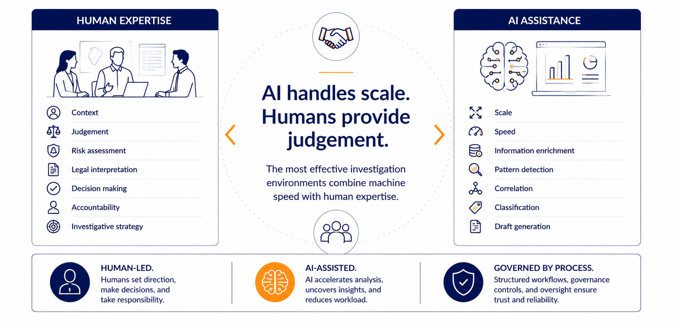
Together, human expertise and AI create investigation processes that are faster, more consistent, and more resilient.
What comes next
The question is no longer whether AI will influence investigation operations.
It already is.
The question is how organisations will integrate these capabilities into their operating models.
Those that treat AI as an isolated tool may achieve incremental gains. Those that embed intelligence into workflows, governance structures, and operational processes will create entirely new levels of efficiency and investigative capability.
At DataExpert Advanced Solutions, this is where we focus our efforts: helping organisations build investigation ecosystems that combine automation, governance, and AI into practical, operationally effective solutions.
The future of investigations is not simply digital.
It is intelligent.
About the author
Jacob Isaksen heads the Advanced Solutions business unit in DataExpert. Located in Copenhagen, Denmark, Jacob focuses on how organisations can combine workflow design, investigation technology, and operational delivery to handle digital investigations more effectively. He was the founder of Avian Digital Forensics in 2015, which became part of DataExpert in 2024, and has long worked at the intersection of digital investigations, eDiscovery, analytics, and enterprise technology.
Before focusing fully on digital investigations, Jacob built more than 20 years of experience across enterprise information management, analytics, software development, and ERP. He writes regularly about digital investigations, AI, sovereign digital architectures, and how organisations can build more secure, scalable and effective investigation capabilities.